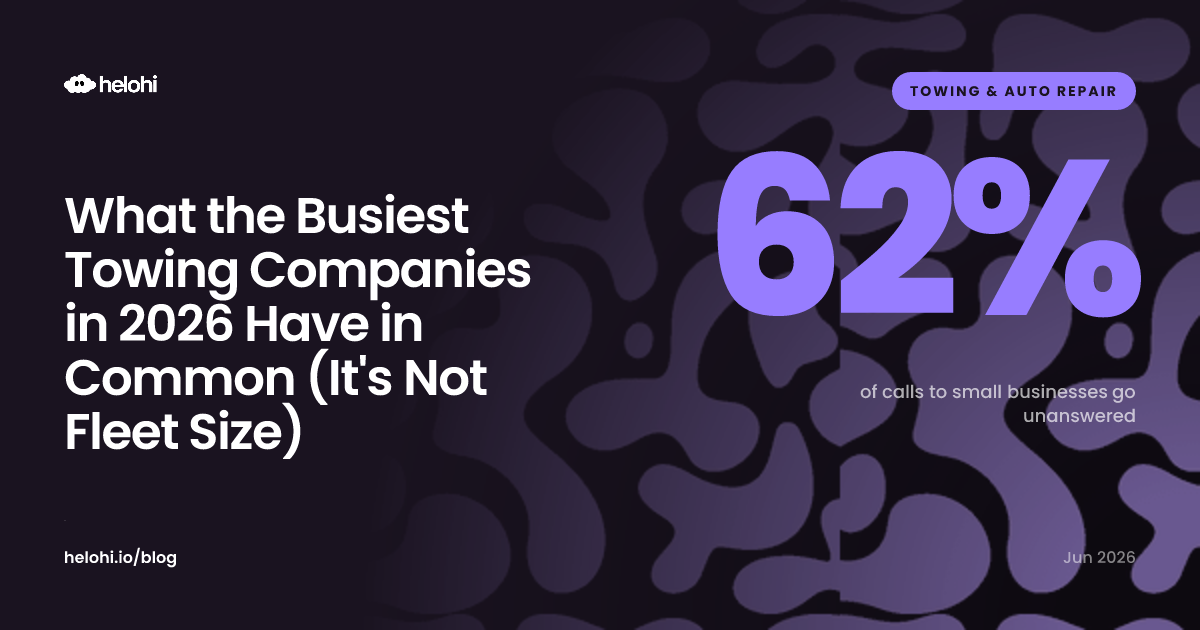
You'd think the busiest towing companies would be the ones with the biggest fleets. Ten trucks instead of three. That makes intuitive sense. More capacity, more jobs, more revenue.
But that's not what's happening.
There are one-truck operators running revenue numbers that match three-truck shops. There are two-truck operations booking more jobs than shops with five trucks. The difference isn't equipment. It's how they move the phone.
The busiest towing operations in 2026 have figured out something that looks obvious in hindsight but takes most shop owners years to see: the person calling in is not your bottleneck. Your ability to capture that call is.
If you own a tow truck, you know this dynamic in your bones. A call comes in at 6pm. You're on a job forty minutes away. It goes to voicemail. By the time you're free and can call back, the customer has found someone else. You lose the job and you never know it was there.
One-truck shops used to be capped by this problem. You can't be in two places. You can't answer a call and be on a road at the same time. So you answered what you could and missed the rest.
The high-volume operators solved it by letting something else answer the phone.
An always-on agent that picks up every call, gets the details, and books the job. The operator doesn't have to be available. The operation is always available. And because the operation is always available, it captures every job that comes in.
That's the throughput difference. It's not capacity. It's capture.
Old model | one truck, owner answers calls, can't do both, misses jobs New model | one truck, agent answers calls, operator does jobs, captures everything
Here's what this looks like in practice. A one-truck shop using this method could theoretically book more jobs than they can physically handle. Some calls would have to be declined or scheduled out. That's the kind of problem every operator wants to have. But most never get there because they're too busy missing calls to book them in the first place.
The busiest shops have done the math and made a choice. They'd rather have the problem of too many bookings than the problem of not knowing how many they lost.
Every call answered | day and night, it doesn't matter Every call booked | the customer confirms and you get a note Every job captured | you know what's available before you finish the current one No gap time | the moment one job ends, the next is lined up
This isn't about looking busy. It's about actually being busy. There's a difference between a full calendar and a lucky calendar. A full calendar is the result of capturing every available job. A lucky calendar is the result of hoping good calls come through during your available hours.
The busy shops in 2026 aren't gambling on luck anymore.
They're not bigger. They're just smarter about which calls they lose. Because they don't lose any. Every inquiry becomes a booking. Every booking becomes a tow. And every tow becomes an invoice.
One recovered job a week pays for an always-on phone system several times over. Most operators discover they're recovering a job or two per day, not per week. That's not incremental growth. That's a different business.
The reason this matters is that it's not a secret anymore. Operators are seeing this pattern, testing it, and building real businesses on the back of it. The ones doing it aren't the ones with the biggest advantage in equipment or experience. They're just the ones who understood that being busy means being reachable.
You could be that operator. One truck, but answering every call. It doesn't cost much to find out.
Call (865) 868-9859 and see how a call would get handled if you set it up this way.
If you want to start capturing the jobs you're missing, helohi.io/get-started is the move.