There's a difference between the home services shops that are busy and the ones that are busy with work that pays. The first kind is always moving. The second kind is just making better decisions about what to move.
In 2026, that difference is mostly about answering the phone.
Not in the way your dad's business did it, with someone sitting at a desk next to a notepad. The best shops today have figured out something different. They've built a system that catches calls even when everyone's in the field, books the appointment while the customer's on the line, and sends a confirmation text before they hang up. Then they go back to work, knowing the next job is already locked in.
This isn't a lucky break thing. It's a pattern you can see across the shops that are actually growing.
1. They answer every single call, even at 2 AM.
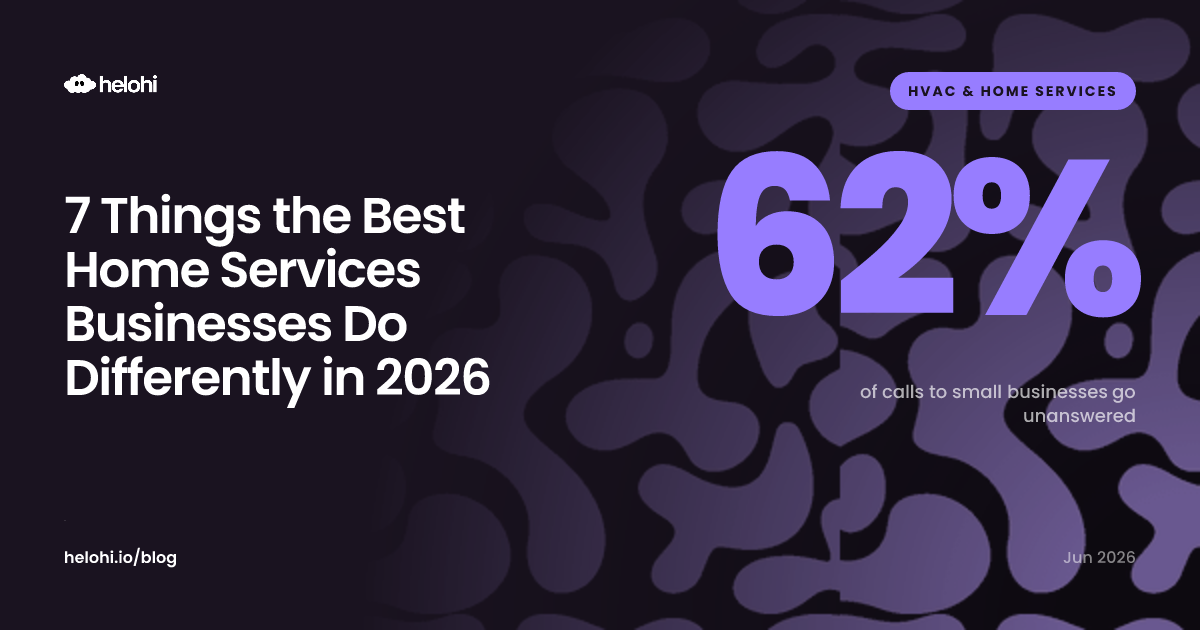
Most shops lose jobs in the gaps. You're on a service call. A new customer dials. Voicemail. By the time you call back, they've already booked with someone else. And it's not your fault. You were actually working.
The winning shops stopped expecting the owner to answer every call. They built a system that does. It sounds like a real person on the phone, talks in the business's voice, and books the appointment directly into the calendar. Twenty calls at once, in under three seconds. The owner never touches the phone.
Most shops | answer one call at a time when someone's free Best shops | answer every call, every time, in under 3 seconds
2. They capture leads at 9 PM on a Tuesday without being awake.
Service doesn't happen during business hours. A heater fails on a winter night. An AC dies in July at 10 PM when people are trying to sleep. That's when they call. And that's exactly when your shop is closed.
Except it's not. Not anymore. The system picks up. Gets the info. Books it. Confirms it by text. And the owner sees a new job waiting in the morning that they had nothing to do with finding. That's about 46% of all service bookings right there, just sitting on the calendar because someone built the infrastructure to catch them.
3. They don't hire a receptionist. They install a system instead.
This is the real shift. In the past, the only way to answer more calls was to hire another person. Now the winning shops do something different. They use a system that costs a fraction of a receptionist's salary and never clocks out.
A human receptionist runs $2,500 to $4,500 a month, works one call at a time, and goes home at 5. The system starts at $199 a month, handles 20 calls at once, and works 24/7. The math is brutal. You could recover one missed job a week and still come out ahead.
4. They stop treating voicemail as a customer touchpoint.
Eighty-five percent of people who hit voicemail never call back. That's not a measurement of how bad your voicemail greeting is. That's physics. Someone needs something now. They call you. You don't answer. They call someone else. Done.
The shops that get this have stopped trying to make voicemail work. They answer instead. And when they do, the call gets booked before the conversation ends.
5. They use text as the confirmation, not the call.
The call is for booking. The text is for remembering. Customers get a confirmation text right after they book the appointment. No follow-up call needed. No "we'll email you." No uncertainty. The text has the time, the address, the technician info, and a callback number. Done.
Most customers prefer this. And for the shop, it drops no-shows because the appointment is sitting in the customer's pocket in writing.
6. They treat after-hours calls like regular calls.
Three-quarters of after-hours calls go to voicemail. That's not because customers are rude or unreasonable. That's because shops built their entire operation around a 9-to-5 schedule. The system answers every call, day or night, because the customer's need doesn't have business hours.
This alone changes the dynamic. You're not competing on price or reputation in those moments. You're just the one who answered.
7. They measure success in booked jobs, not answered calls.
This is the mindset shift that pulls it all together. A shop that answers every call but still has to manually enter it into the schedule and send a follow-up email has just made more work. The winning shops measure different. Did the call turn into a booked job? Did the customer get a confirmation? Did the team see it in their calendar?
Those are the metrics that matter.
Someone calls | the system answers in under 3 seconds They book the appointment | directly into your calendar They get a confirmation | text with all the details You wake up | to a full schedule you didn't have to build
The infrastructure to do this exists now, and it's not expensive. The shops that set it up in early 2026 are already seeing the difference. They're busier, but they're not the ones answering the phone anymore.
They're the ones actually doing the work.