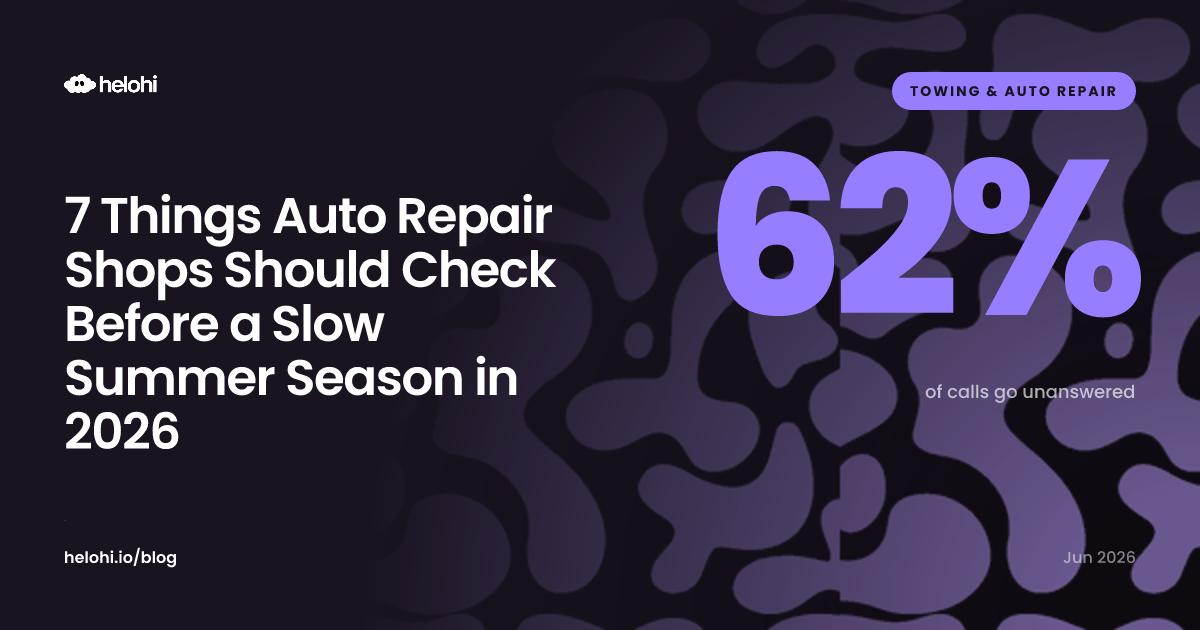
Summer is coming, and for auto shops, that usually means a slowdown. Less frequent breakdowns. Fewer emergency repairs. People drive less when the weather's good. You feel it in your schedule.
But the slowdown is also a preview of what happens if your systems fail. When business is tight and every job matters, missed calls become catastrophic. A customer can't reach you and just drives to another shop. That's not business you can afford to lose in slow season.
This is what slow season exposes. You can't afford gaps in these areas.
Before July hits, it's worth checking a few things on your operation. Not overhauls. Just the basics that keep jobs from falling through.
1. Check if your phone is actually ringing when you're busy.
You know you miss calls when you're under a car. The question is how many. If you're missing most daytime calls because you can't answer with both hands on an engine, that's going to hurt more when volume drops. You'll have less buffer.
Test it. Have someone call your shop number while you're deep in a repair. How long until they reach someone? Do they get voicemail immediately? If yes, that's something to fix before slow season arrives.
2. Check your voicemail greeting.
If it's generic or outdated, update it. A customer who hits voicemail at least hears that it's the right shop and that you're real. A voicemail that sounds like the default message on a phone system sounds like nobody set it up.
3. Check your hours posted online.
This is a small thing that breaks slowly. Google My Business, Yelp, your website, Facebook. Make sure they all say the same hours. If someone's looking you up at 5 PM on Saturday and your listing says you close at 4, they've already moved on to the next shop.
4. Check if you're staffed for after-hours calls.
Most car problems don't happen during the day. A customer's engine overheats at 7 PM. Their transmission fails at 8. These are the calls that come in when your office is empty. If you're the owner answering your phone at night, that's one thing. If the shop just goes dark after 5, you're leaving money on the table.
5. Check that your booking process actually works.
If a customer calls and wants to schedule, what happens next? Does your front person remember to enter it into the system? Does it sync with your actual capacity? Or do you overbook, lose details, and disappoint customers?
Slow season reveals gaps in process because the stakes are higher. When you're busy, one mistake is buried in the volume. When you're slow, one customer dissatisfaction becomes a bad review that costs you more than the original job was worth.
6. Check what you're actually capturing after hours.
If you have an answering service or voicemail, track it for a month. How many calls are you getting between 5 PM and 8 AM? You probably think it's a small number. Most shops are surprised to find out it's not.
7. Check if you're ready to handle the jobs you do get.
This is the meta one. In slow season, you want to close jobs faster, not lose them. If a customer who actually reaches you then has to wait a week for an appointment, they leave. If they book a time and then you're not ready to take them, they're gone.
Make sure your team knows you're in slow season and that every committed job matters. If a customer is coming in, the work should be ready and the shop ready to take them.
The quick fix for most of this.
Most of the above require someone paying attention during slow hours. But if you're a one or two-person operation, that's going to burn you out. The one thing that fixes the biggest hole is making sure something answers your phone 24/7.
When a customer calls at 7 PM on a Sunday (which is when they usually do because their car broke), an agent trained on your shop can get their basic information. What's wrong, what's the vehicle, what's the urgency. If they need immediate help, you know. If they can wait until Monday morning, they have a time slot. Either way, the call isn't disappearing into voicemail.
helohi is trained on your shop. When a call comes in, it answers. It gets the customer's details and creates a dispatch or appointment. The customer gets a confirmation text. You wake up Monday morning and already have your day scheduled.
Customer calls after hours | agent answers Agent gets vehicle and problem details | asks the right questions You see the job the next morning | already on your calendar
You can integrate it with your shop's existing tools or just get notified that a job is waiting. Either way, you're not losing calls to voicemail anymore.
The shops that make it through slow season aren't bigger. They just don't let jobs walk away because they couldn't answer the phone.
If you want to make sure you're not losing after-hours jobs this summer, start at helohi.io/get-started.