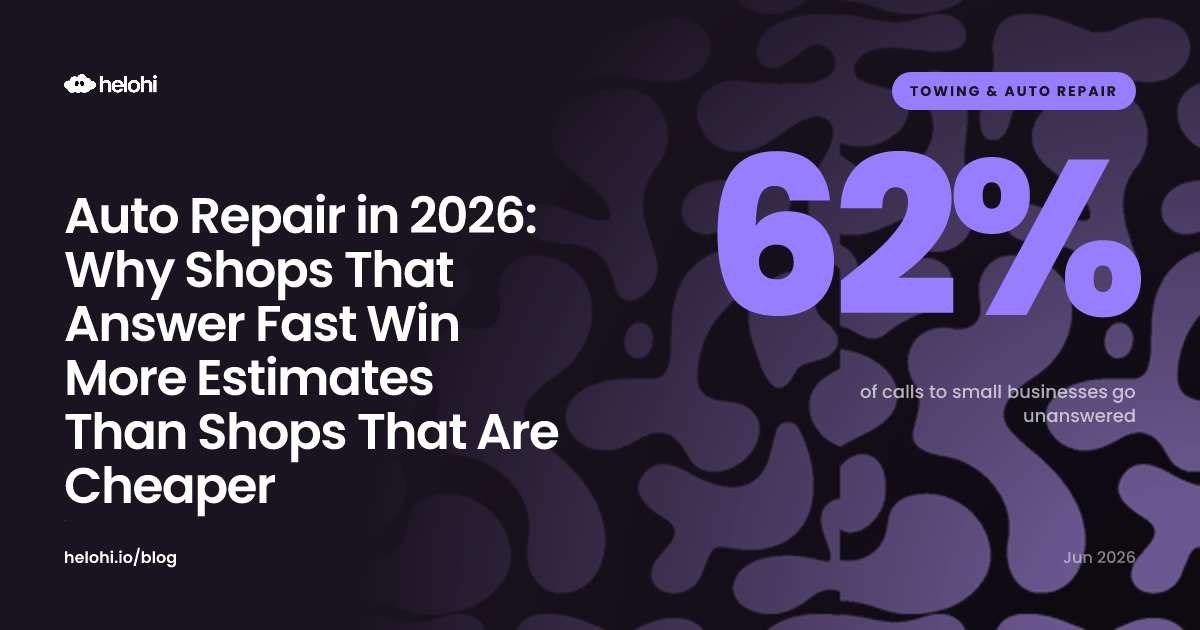
Sarah called four auto shops about a check-engine light. The first number went to voicemail. The second ring and a person answered immediately. She got an appointment for the next day. She never called shops three and four.
That shop wasn't necessarily the cheapest. They just picked up.
In 2026, this is how auto repair works now. The speed of the answer matters more than the price quote. If you answer in 15 seconds, the customer books with you. If you call them back in two hours, they've already moved on.
The Shift That Happened
Five years ago, an auto shop could get business by being cheap. Customers would call three shops, get quotes, compare prices, and book the lowest one. The shops with the fastest price quotes won.
That's not how it works anymore. Customers still want a good price, but they want it fast and with minimal friction. The shop that answers the call and can see them tomorrow wins over the shop that calls back with a better quote in two hours.
It's not a psychological thing. It's practical. When a customer's check engine light is on, they're anxious. They want to know what's wrong and get it fixed. The shop that can see them immediately and give them an answer feels safer than the shop that makes them wait.
Old model | customer shops multiple stores, books the cheapest New model | customer calls first shop with availability, books same-day appointment
Why Being Slow Costs More Than Being Cheap
When you don't pick up the phone immediately, the customer doesn't wait for a callback. They call the shop next to you or the one they already trust. By the time you call back, they're already scheduled elsewhere.
Even if they're still looking, you're now competing to move them off a committed decision. The appointment they just booked is a done thing. Your lower quote isn't worth rescheduling their afternoon.
One missed call a day doesn't seem like a lot. But it adds up. At a typical auto shop with an average job of $400, you're losing $8,000 a month in revenue just from calls that go to voicemail.
When customers can't reach you, they're gone. The math is simple.
How to Answer Every Call (Without Hiring)
The shops winning in 2026 don't route calls to voicemail. They route them to someone who can help.
For a solo shop, a virtual receptionist answers during the lunch rush. For a shop with an office manager, they work a shift that covers busy calling times. For shops that can't do either, a call queuing system lets callers know you'll be there shortly, but doesn't let the call drop. All three solve the same problem: the customer doesn't hang up thinking they've reached a dead line.
Know your busiest calling hours | usually 8am to 10am and 5pm to 6pm Make sure someone is available during those hours | whether it's you, an employee, or a virtual service Answer within three rings or let them join a queue | never let them hit voicemail
The Pricing Question
You might think that to stay busy, you also have to drop prices. It's not true. A shop that answers fast and gives good service can charge the same or more than a shop that's cheap but slow.
The customer calling about a check-engine light isn't trying to save $40. They're trying to solve a problem. If you answer fast, get them in, diagnose it, and fix it, they'll pay. If you make them wait three days for an appointment at a cheaper shop, they go elsewhere.
Pricing matters. But timing matters more. The shop that offers a $150 diagnostic in two hours beats the shop offering the same diagnostic for $100 next week.
What to Do Today
Measure how many calls go to voicemail. Most shop owners underestimate it. Look at your busiest hours, usually 8am to 10am and 5pm to 6pm. During those windows, answer every call or have a system that takes information and promises a quick callback in 30 minutes, not two hours. You'll be shocked at how many people book if you just answer the phone.
Pricing Still Matters, But It's Secondary
The shops that are thriving in 2026 aren't the cheapest. They're not the most expensive either. They're the ones you can reach.
A customer walking in your door with a problem already half-solved (because they got to talk to you when it happened) is worth more than a customer who took three days to shop around and now has a list of other quotes.
Speed of answer, then quality of service, then competitive pricing. That's the order in 2026.
The fastest shops win. It's not a theory. It's happening right now.