Three years ago, after-hours towing was a differentiator. You offered it, your competitor didn't, you won. Now it's table stakes.
The market has shifted. Customers expect to reach someone. If you can't, they assume you're closed permanently, not just for the night. They move on.
But here's what's interesting: most towing operations still can't actually do it. Not because they don't want to. Because answering calls at 2am while running a full operation during the day is exhausting and expensive.
So there's still a gap. The shops that figured out how to answer every call, any hour, without burning out their team are pulling ahead. And they're not necessarily the biggest shops. Some of the fastest-growing ones are lean outfits that solved the availability problem without hiring night-shift staff.
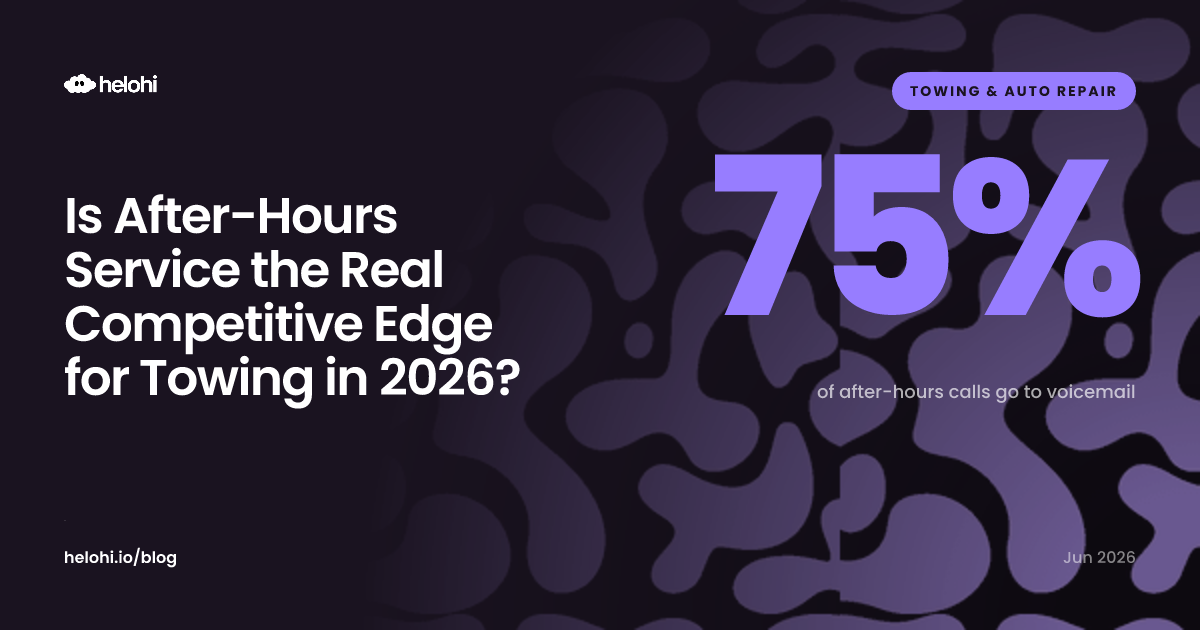
The voicemail problem is brutal at night. Someone's car dies at 11pm. They're frustrated, possibly stuck somewhere unsafe. They call you. Voicemail. They call your competitor. Real person picks up. Three minutes later, they've got a tow routed to them instead of you. You never knew the call happened.
But here's what the data shows: almost half of all service bookings happen outside business hours. That's when people's cars fail. Not during your 9-to-5. At 3am on a Tuesday, on a Friday night, on Sunday afternoon when you're supposed to be off. That's when demand actually peaks.
If you can only answer during business hours, you're watching half your market volume go to whoever can answer the other half. The math there is dire.
Customer car breaks at 9pm | they're stranded, they need help now They call and reach a real voice | intake happens immediately, tow is dispatched They get a text with the driver's eta | they know help is coming, they're not panicking Your shop wakes up to a full morning | jobs are already in the system, drivers know what's happening
The traditional solution was hiring someone to answer the phone overnight. You'd pay them to sit in a dispatch office from 5pm to 9am whether it's busy or dead. Insurance gets more complicated. Scheduling becomes a nightmare. You're adding overhead just to match what your competitor is offering for free.
Some shops tried third-party answering services. You call a place, they take a message, they text you the message hours later. Customers hate the lag. They want answers now, not voicemail theater.
helohi changes the equation. It answers calls after-hours without the headcount. A customer reaches someone at midnight and gets real availability. Can you help tonight? Yes. When can someone be there? Thirty minutes. Boom. Job is booked. Confirmation text goes out. Your team wakes up and the tow is already in the system.
You're not paying overtime. You're not managing a night-shift person. You're not dealing with a third-party who takes three hours to relay information. The call gets answered, the job gets captured, and your dispatcher has perfect intelligence in the morning.
What separates shops pulling ahead from the rest is how they handle this gap. The comparison is stark:
| Solution | Result | Cost |
|---|---|---|
| Third-party answering service | Voicemail-to-voicemail chain, jobs come in late | $300+ per month |
| Night-shift dispatcher | Jobs captured same-day, but salary, benefits, management overhead, burnout | $2,500-$4,500 per month |
| helohi 24/7 AI availability | Jobs captured in real-time, zero overhead, no burnout | $449-$899 per month |
The competitive advantage here isn't just availability. It's the data. If you're answering every call, you start to see patterns. Peak demand times. Customer segments. What types of calls come in at night versus day. You get visibility into real market demand, not just the demand you happen to be available for.
A towing shop that answers every call isn't competing on price anymore. They're competing on speed and reliability. Customer calls, someone answers. Help comes fast. Confirmation is instant. Reputation spreads. The next customer picks them first because they heard they actually pick up.
By 2026, the question isn't whether you should offer after-hours service. It's whether you can afford not to. Every week you're not answering calls after hours, you're bleeding jobs to someone who does.
The financial case for helohi is straightforward. A human night-shift receptionist runs $2,500-$4,500 per month. helohi starts at $449 per month and captures roughly 110 new bookings per month for founding clients. At an average towing job value of $180 to $300, that's real money recovered.
The towing shops winning right now are the ones who figured out that availability is the business. Not the truck. Not the mechanics. The answer to the phone.
If you want to be one of them, helohi.io/get-started is where to start.