It's 2am. A Honda Civic slides off I-75 into a ditch near Knoxville. Driver pulls out their phone and finds three tow shops on Google. They call the first one. Straight to voicemail. Second one. Same thing. Third one answers.
That's your job.
Most tow shops run lean. You have a dispatcher who handles day calls, maybe one driver on night shift, and that's it. When calls come in at night, they either go to a driver's personal cell or they go to voicemail. Both are chaos. A driver can't take calls and tow at the same time. Voicemail doesn't dispatch anyone.
The customer just needs their car picked up. They don't care if you look busy. They just need to reach someone who can help.
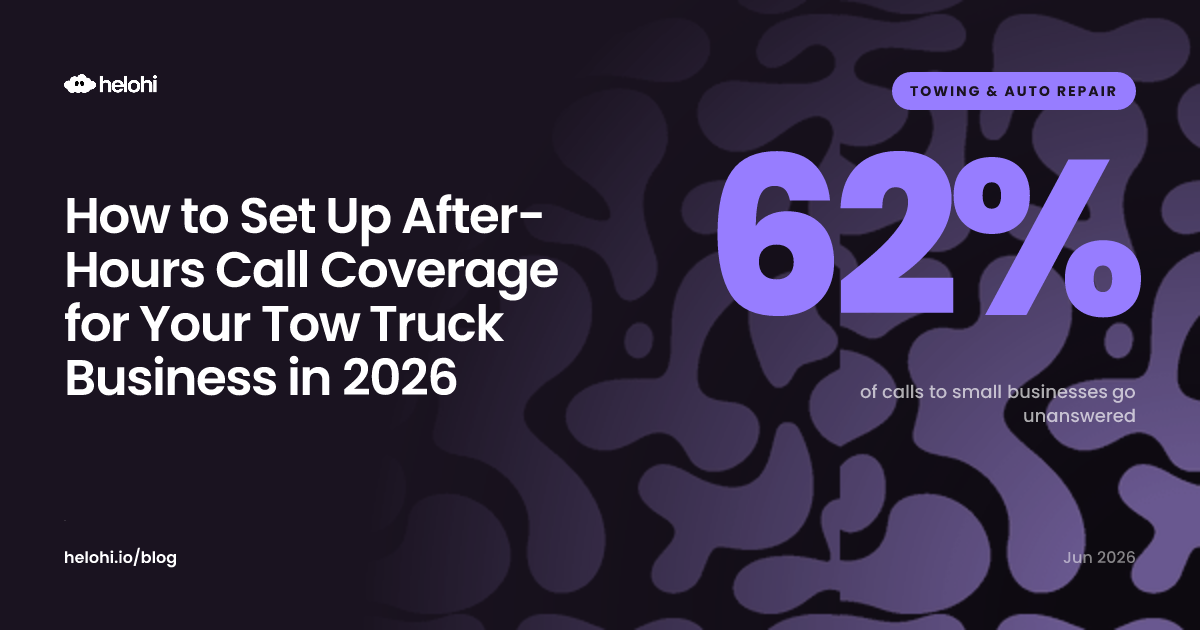
For a tow shop, that stat is worse than the industry average. Towing is emergency service. A missed call isn't just a booking problem. It's reputation damage in a small market. Your customers are panicked, they're wet, they're stranded. If no one answers, they're calling the next number on Google right now.
And there's another layer. A breakdown doesn't predict your schedule. You can't staff for random 3am calls the same way a salon staffs for Saturday. You need something that answers when everyone's home in bed.
A driver answering their phone | they're towing, not dispatching A dispatcher at night | $1,200-$1,800/week for one person Voicemail | 80% of callers hang up and call someone else
The setup you need is different from a service business. You need live answering, but the dispatcher needs to know what to do with the information. A booking system isn't enough. You need dispatch capability.
First, get a dedicated dispatch number. Your business number probably routes to a person or voicemail. Get a second line, a Google Voice number, or a Twilio number that can do call routing. Post it on your Google Business Profile, your website, and every vehicle. Make it the number people actually call when they need help. It should be easy to find and easy to dial in a panic.
Second, set up a dispatch group. You probably have a group text with your drivers already. Create a dispatch protocol. When a call comes in after hours, it gets routed to a system that collects the information (where they are, what they need, what vehicle), then dispatches it to your group. Every driver sees the job at the same time. The closest one, or the one on shift, takes it. This beats a driver trying to answer their phone while driving or moving a car.
Third, build a simple intake form. When someone calls, they need to tell you the same things every time. Location. Vehicle. What happened. Is it currently blocking traffic? When do they need the tow? A quick form, either on the phone or through a text, captures this and passes it directly to your dispatcher. It's cleaner than playing phone tag.
Fourth, use text dispatch as a backup. Some people prefer texting, especially if they're in a stressful situation and don't want to talk. A texting number that says "Text us your location and what you need towed" gives them an option. Text comes in, your team gets notified, a driver responds. Same dispatch workflow, different channel.
Customer calls dispatch line | they reach a live service or system Details are collected | location, vehicle, urgency Job posted to your dispatch group | all drivers see it at once Closest driver accepts and responds | customer gets pickup time
Here's the reality of towing in 2026. Your competition is probably ignoring half their 3am calls. They're either not staffed or they're using the same broken setup everyone else is. If you answer every call, even when you're closed, you win jobs that should go to someone else.
The cost structure is straightforward. One recovered tow a week, that's $200 to $500 depending on the type of tow. A week of recovered tows when you're currently dropping calls is $800 to $2,000. A month is $3,200 to $8,000. That's a whole driver's salary. That's what you're currently leaving on the road.
Most tow shop owners don't think about this as a call coverage problem. They think about it as a staffing problem. "I'd need to hire someone to cover night shift." That's one answer. A more precise answer is "I need to handle calls better at night." Those are different problems with different solutions.
A system that answers every call, collects information, and dispatches to your team doesn't require a new hire. It requires a setup once and a commitment to checking dispatch messages. That's lower friction than adding payroll.
The other factor is that your customers in a breakdown aren't thinking about cost. They're thinking about speed. They just want someone there. If you answer the call and commit to a pickup time, most won't shop around. If they get voicemail, they're already dialing the fourth number.
Being the shop that answers every call, every hour, is a huge competitive advantage in a market where most shops don't. You don't have to be the cheapest. You just have to be the one they can reach.
The tow industry is changing. Big national chains are betting on call centers and logistics. What they miss is that local trust matters. Your customer had a breakdown. They called a local number they found on Google. Someone answered. Someone's coming. That's the whole game.
Set up your dispatch line. Train your drivers on the protocol. Answer every call. The 3am jobs that everyone else is dropping are the ones that will make your quarter.