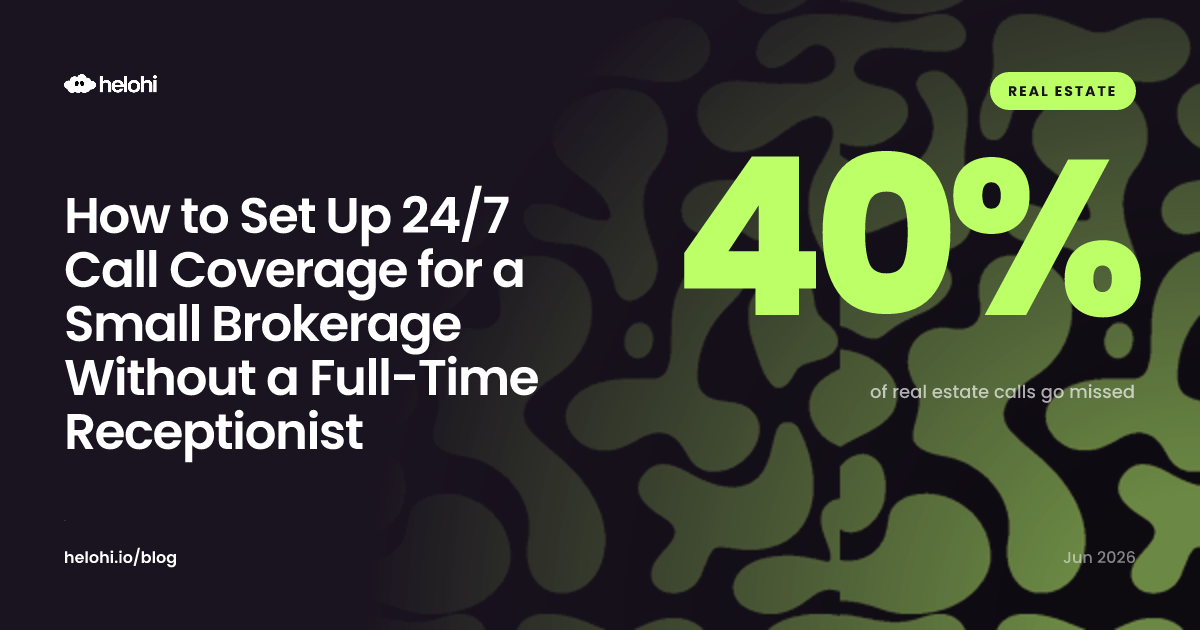
A client calls your brokerage at 6pm on Friday. No one's in the office. The call goes to voicemail. By Monday, they've already called three other brokerages.
This isn't a rare problem. It happens dozens of times a month at most small real estate offices.
The challenge is real: you need someone to answer calls, but hiring a full-time receptionist costs between $2,500 and $4,500 per month, and they still can't cover after-hours calls.
Here's what actually happens when you don't answer. A potential buyer or seller reaches your brokerage. They're ready to move forward. Your voicemail picks up. They hang up and dial the next brokerage. By the time you listen to the voicemail, they've already booked an appointment somewhere else.
The answer isn't to hire another person. It's to set up a system that handles calls when your team can't.
Step 1: Choose your coverage hours
Start by deciding what "24/7" means for your business. Most small brokerages need:
- Business hours coverage (9am to 5pm, Monday through Friday) to handle peak inquiry volume
- After-hours coverage (5pm to 9am) for evening and weekend calls
- Holiday coverage for major holidays when no one's in the office
Some brokerages expand this to include late-night emergency calls from sellers who've had a change of plans or buyers in crisis mode.
Identify gaps | when do you lose calls today? Set priorities | which hours matter most? Build a schedule | map coverage to your actual rhythm
Step 2: Get a business phone number
You need a phone number that clients recognize as yours. If you're relying on personal cell phones, calls get missed when agents are with clients.
Options:
A dedicated business number costs nothing to set up. You'll direct it to an answering system during off-hours and to agents during business hours.
Some brokerages use a virtual receptionist number that's staffed live during business hours, then rolls to automation after 5pm.
The number stays consistent. Clients call the same line whether it's Tuesday at 2pm or Saturday at 11pm.
Step 3: Set up your after-hours system
This is where most brokerages stumble. At 6pm, when the office empties, calls still come in. They need to go somewhere that makes sense.
Option 1: Voicemail goes nowhere. Clients hang up. You never hear from them again.
Option 2: Voicemail captures their info. You call them back Monday. They already booked elsewhere.
Option 3: An answering system picks up, qualifies the call, and books the appointment directly into your calendar. The client gets a confirmation text before you even see the call.
The third option is the only one that wins deals.
An automated call system works like this:
The phone rings after business hours. A voice answers and confirms they've reached your brokerage. It asks what they're calling about. Are they selling a property? Buying? Renting? The system captures their response, their name, phone number, and any details they volunteer.
Then it checks your team's calendar and offers available appointment times, directly to the caller. If they book, a confirmation text goes to their phone immediately. Your calendar updates in real time. The agent walks in Tuesday morning to a schedule that was filled while they were asleep.
Step 4: Choose your technology
You have three paths.
Hire a live answering service. They handle calls around the clock with real people. Cost: $1,500 to $3,000 per month. A person answers your line, takes notes, and forwards them to you. Good for high-touch calls. Bad for capturing appointments automatically.
Use a voicemail system tied to your calendar. Client calls after hours, leaves a message, you call them back. Cheaper but still loses most customers.
Use an automated system that answers calls 24/7, qualifies them, and books appointments directly. No human answering service. No voicemail gaps. No missed opportunities.
Live answering service | expensive, one call at a time Automated system | 24/7, handles 20 calls at once
The automated path costs far less than hiring a person, and it actually closes more deals because the system answers immediately and confirms the appointment before the customer hangs up.
Step 5: Train your team on the workflow
Your system will work perfectly on paper. Then a client books an appointment with the system after hours, and Tuesday morning your agent has no idea where it came from.
Make the workflow crystal clear:
All after-hours bookings go into a shared calendar that everyone checks first thing in the morning. Your client confirmations are flagged. Agents know which calls came from the system.
If a client books a callback rather than an appointment, the system logs it with their full context. Your team member calls back informed.
Set a team rule: anyone who gets a callback from someone who booked after hours should mention they were connected while the office was closed. It reinforces that you're available 24/7.
Step 6: Test it before going live
Call your own line from a different phone. Does it answer as expected? Can you actually book an appointment? Do you get a confirmation text?
Ask a trusted agent or friend to call it. Get their honest feedback on whether they'd trust the system with their information.
Run it live for a week. See what happens. Adjust the greeting, the booking options, or the follow-up timing based on real calls.
Most brokerages find that their first week of 24/7 coverage captures five to eight deals they'd normally miss. Once you see that happen, you'll never go back.
The alternative is simple: keep answering phones personally until you're exhausted, keep missing calls while you're in showings or closed deals, or hire someone and pay $30,000 to $54,000 a year for coverage you still can't extend to nights and weekends.
Or set it up once and let it work for you 24/7.